
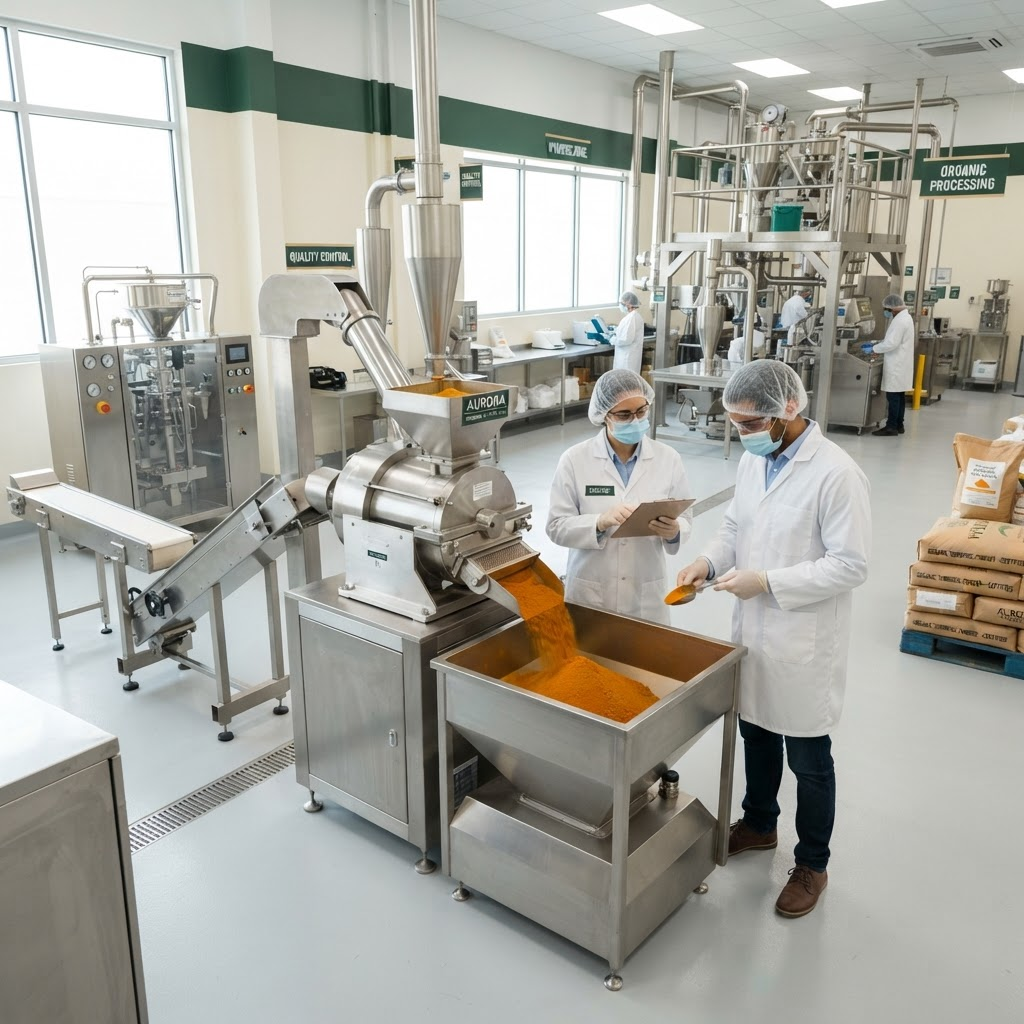
The Multi-Tiered Safety Architecture
In global food processing, nutraceutical blending, and spice distribution, safety and compliance are not marketing slogans—they are legal obligations and moral mandates. At Jugrajj Food & Herbs, our processing facility in Punjab operates under a strict, validated HACCP-driven Quality Management System (QMS) designed to eliminate physical, chemical, and biological contamination risks before products ever depart our warehouse.
From initial seed selection and farmer intake testing through multi-stage dehydration, cryogenic pulverization, and vacuum packaging, every stage of our supply chain is documented, auditable, and traceable to individual agricultural lot numbers.
Global Certifications: APEDA, FDA, FSSAI, GMP & ISO 22000
To serve top-tier food processors in North America, Europe, the Middle East, and Asia-Pacific, Jugrajj Food & Herbs maintains active registration and third-party certifications with the world's most stringent regulatory authorities:
- APEDA (Agricultural & Processed Food Products Export Development Authority): Certified for agricultural export compliance, phytosanitary standards, and authentic Indian origin verification.
- US FDA Registered Food Facility: Validated compliance under the Food Safety Modernization Act (FSMA 204), enabling seamless importation into the United States.
- FSSAI Central & State Licenses: Comprehensive licensing under the Food Safety and Standards Authority of India for primary processing, repacking, and wholesale distribution.
- GMP (Good Manufacturing Practices): Certified facility sanitation, air-filtration validation, clean-in-place (CIP) stainless lines, and employee hygiene compliance.
- ISO 22000:2018 & HACCP: International standard for food safety management systems, integrating hazard analysis at critical control points across the entire processing lifecycle.
Analytical Testing Protocols: Heavy Metals, Pesticides & Microbiology
Every commercial production batch undergoes mandatory analytical clearance by accredited NABL/ISO 17025 third-party laboratories. Batches are released for dispatch only when certified against the following parameters:
- Heavy Metal Screening (ICP-MS): Lead (Pb) < 1.0 ppm, Arsenic (As) < 0.5 ppm, Cadmium (Cd) < 0.2 ppm, Mercury (Hg) < 0.1 ppm.
- Multi-Residue Pesticide Screen (LC-MS/MS & GC-MS/MS): Rigorous testing against a 250+ compound panel covering organophosphates, carbamates, organochlorines, and pyrethroids, ensuring non-detectable or strictly below EU/US MRL limits.
- Microbiological Tolerances: Total Plate Count (TPC) < 50,000 CFU/g, Yeast & Mold < 500 CFU/g, Coliforms < 10 CFU/g, with Salmonella and E. coli strictly absent in 25 grams.
- Aflatoxins & Mycotoxins: Total Aflatoxins (B1+B2+G1+G2) < 4.0 ppb; Ochratoxin A < 10.0 ppb.
Clean-Room Processing & In-Line Metal Detection
Physical contamination—such as metal fragments from worn machinery, stone grit, or plastic fibers—represents an unacceptable hazard for commercial food manufacturers. Our processing infrastructure includes multi-tiered physical defense mechanisms:
- Air Handling Units (AHU) with HEPA Filtration: Positive-pressure clean rooms prevent environmental ambient dust and microbial spore infiltration into milling and packaging chambers.
- Multi-Deck Vibro-Sifters: Calibrated stainless steel meshes remove oversize particles, fibers, and foreign matter before milling.
- In-Line High-Sensitivity Metal Detectors: Sensitive dual-frequency search coils detect ferrous (≥0.8 mm), non-ferrous (≥1.0 mm), and stainless steel (≥1.2 mm) particles, automatically rejecting any contaminated bag instantly.
Batch Traceability & Certificate of Analysis (CoA) Verification
Every commercial carton, drum, and retail pouch leaving our facility features a machine-readable barcode and serialized lot identifier. This lot number links directly to the production run records, farm intake receipts, internal QA logs, and third-party Certificate of Analysis (CoA).
Global buyers receive a comprehensive lot-specific CoA with every shipment detailing moisture percentage, volatile oil content, bulk density, active markers (such as curcumin or withanolides), and microbiological test results. This full transparency guarantees absolute confidence for food processors formulation-ready ingredients.


